Daily scoring with MyKeego Drive: 4.99/100, well below moderate risk
A rental fleet serving delivery-app riders uses MyKeego Drive's driving score as a daily control and as a condition to renew each rental. In a sample from the fleet, the average score sits well below the moderate-risk threshold.
Results
- Sample average score: 4.99 out of 100 (100 = worst case) — well below the 20-point threshold for moderate driving
- Sample of 3 vehicles from the fleet, with daily score review tied to rental renewal
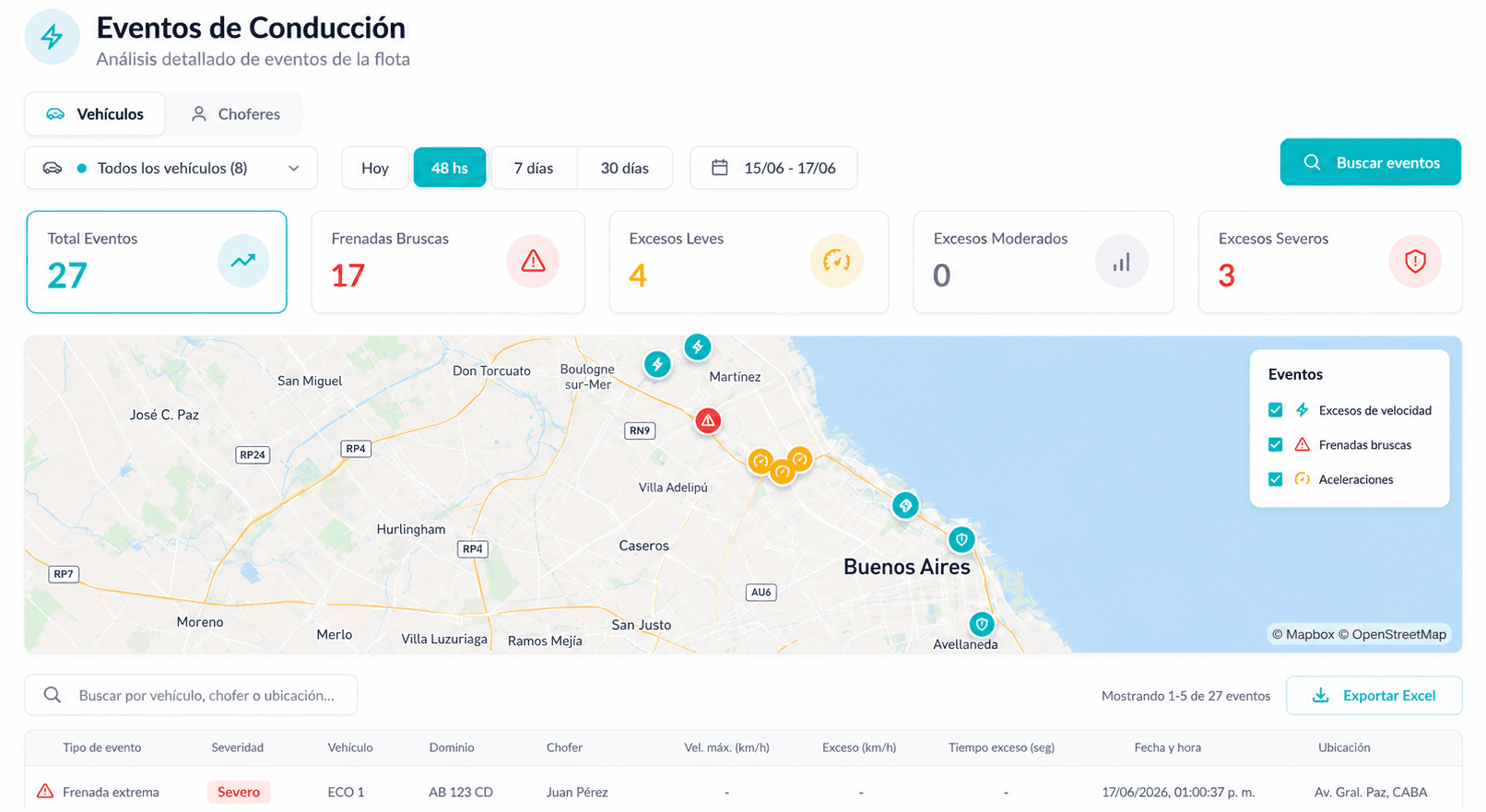
- Road-position (speeding) and accelerometer (harsh braking) metrics, over real exposure: engine-on hours and kilometers driven
- The score, reviewed daily, works as a real operational condition to renew — or not — each driver's rental
Average score of 4.99 out of 100 (100 being the worst possible case), well below the 20-point threshold for moderate driving.
The challenge
Renting vehicles to app-based delivery drivers means high driver turnover and little direct control over driving style: the operator isn't in the car, and a single vehicle can pass through several drivers in just a few months. Without visibility into driving behavior, accident risk — and the repair costs, downtime, and insurance renewal it brings — falls entirely on the operator. In comparable delivery-driver rental operations, without this kind of control, reported accident rates tend to run higher than in fleets with dedicated drivers and direct supervision.
The MyKeego solution
MyKeego Drive computes a monthly score per vehicle and per driver, on a 0–100 scale where 100 is the worst possible case, from events detected via road position (GPS, speeding) and accelerometer (harsh braking), against each vehicle's real exposure — kilometers driven and engine-on hours. Within that scale, 20 points is the ceiling for "moderate driving": below that threshold, driving is considered low risk.
This fleet's operator doesn't wait for month-end to check the score:
- Reviews the ranking every day, not monthly.
- Uses it as a condition to renew each driver's rental contract.
- That creates a direct behavioral incentive: the driver knows their driving determines whether they keep access to the vehicle.
Measured results
As a sample, this is what the MyKeego Drive dashboard looks like for 3 vehicles from this fleet over the period 06/09/2026 – 07/09/2026 (the full operation runs more units; these three are representative of the fleet's overall behavior):
| Unit | Speeding | Harsh braking | Engine-on hours | Accumulated km | Ranking for the month |
|---|---|---|---|---|---|
| Unit 1 | 1 | 29 | 52.48 | 895.55 | 4.45 |
| Unit 2 | 7 | 4 | 71.69 | 1,314.77 | 4.76 |
| Unit 3 | 28 | 8 | 125.12 | 2,585.94 | 5.75 |
Sample average score: 4.99 out of 100. All three units sit well below the 20-point threshold for moderate driving — in this sample, the fleet operates in a low-risk band according to MyKeego Drive's score.
Daily control as a lever on accident risk
The value of this dashboard isn't just the month-end number — it's that the operator reviews it every day and ties it to a concrete operational consequence: rental renewal. A driver with a rising score has time to correct course before month-end; a driver who stays clear of the risk threshold keeps their rental.
This mechanism — infractions detected via road position and accelerometer, a visible daily score, constant operator review, and a real consequence tied to vehicle access — is what lets this operation keep its scores well below the moderate-risk threshold. It isn't a measurement of actual accidents for this specific fleet, since MyKeego doesn't manage that data, but it's consistent with what's observed in usage-based telematics more broadly: monitoring and acting on driving behavior, before it turns into an accident, is controlling risk at the point where it can still be controlled.
More than a monthly number
MyKeego Drive is configured to fit each operation: which infractions weigh more, what risk thresholds apply, and what operational consequence — an alert, coaching, or non-renewal — fires at each band. In a delivery-driver rental operation, where the operator isn't in the car, that daily control is the difference between reacting to an accident and preventing one.